1. Two parallelograms are on equal bases and between the same parallels. The ratio of their areas is
2. ABCD is a quadrilateral whose diagonal AC divides it in two parts of equal area, then ABCD is a
3. If a triangle and a parallelogram are on the same base and between same parallels, then the ratio of the area of the triangle to the area of parallelogram is
4. The median of a triangle divides it into two
5. PQRS is a parallelogram and A and B are any points on PQ and QR. If ar(PQRS) = 48 cm², then ar(ΔPBS) + ar(ΔASR) is equal to
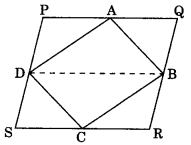
6. A, B, C and D are the mid-points of sides of parallelogram PQRS. If ar(PQRS) = 36 cm², then ar(ABCD) is
7. ABCD is a trapezium in which AB || DC. If ar(ΔABD) = 24 cm² and AB = 8 cm, then height of ΔABC is
8. PQRS is a parallelogram. If X and Y are the mid-points of PQ and SR and diagonal SQ is joined, then ar(XQRY) : ar(ΔQSR) is
9. In quadrilateral PQRS, M is the mid-point of PR. If ar(SMQR) = 18 cm², then ar(PQMS) is
10. D and E are the mid-points of BC and AD respectively. If ar(ΔABC) = 12 cm², then ar(ΔBDE) is