2. If \(\bar { x } \) represents the mean of n observations x1, x2, ..., xn, then value of \(\sum_{i=1}^{n}\left(x_{i}-\bar{x}\right)\) is:
4. Let \(\bar { x } \) be the mean of x1, x2, ..., xn and y the mean of y1, y2, ..., yn. If z is the mean of x1, x2, .... xn, y1, y2, ..., yn, then z is equal to
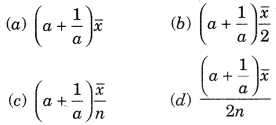
5. If \(\bar { x } \) is the mean of x1, x2, ..., xn, then for a ≠ 0, the mean of ax1, ax2, ..., axn, \(\frac{x_1}{a}\), \(\frac{x_2}{a}\), ........, \(\frac{x_n}{a}\) is
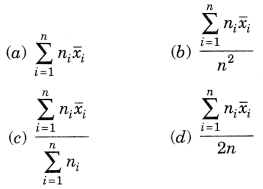
6. If \(\bar { x_1 } \), \(\bar { x_2 } \), \(\bar { x_3 } \), ........, \(\bar { x_n }\) are the means of n groups with n1, n2, ....... nn number of observations respectively, then the mean x of all the groups taken together is given by:
7. The median of the data
78, 56, 22, 34, 45, 54, 39, 68, 54, 84 is
9. Mode of the data
15, 14, 19, 20, 16, 15, 16, 14, 15, 18, 14, 19, 16, 17, 16 is